
The global logistics solutions market has crossed the $12 trillion mark, now accounting for roughly 11% of global GDP, according to 2026 data from Statista and the World Bank. What’s changed the equation isn’t the trade volume alone but the technological stride, such as AI, automated freight management platforms, and real-time visibility tools.
For companies importing components, exporting finished goods, managing e-commerce fulfillment, or coordinating complex international freight, this changes the definition of a competitive supply chain. The future of global logistics solutions will be built around connected data, intelligent decision-making, flexible transportation networks, and proactive risk management, not technology for technology’s sake. This piece looks at where the technology is actually moving the needle, what it means for how businesses choose global logistics solutions, and why the next few years will reward companies that treat supply chain visibility as a strategic asset rather than a back-office function. Let’s get rolling.
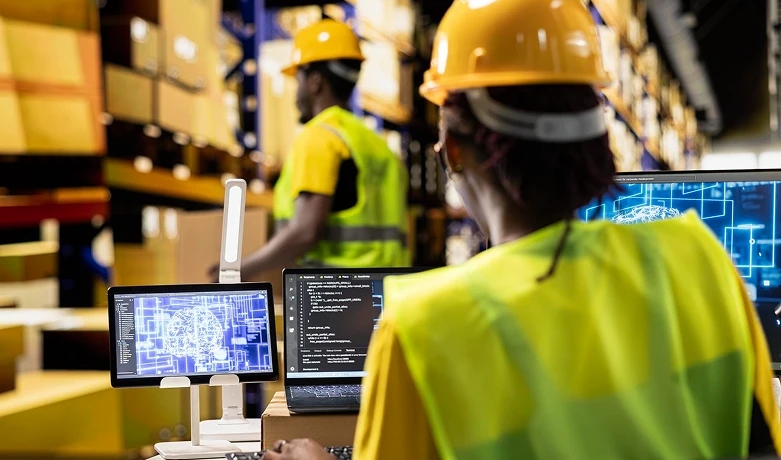
Global supply chain management: Present & Future
The numbers demonstrate just how interconnected North American commerce has become. The U.S. Bureau of Transportation Statistics reports that trade between the United States, Canada, and Mexico reached $1.6 trillion in freight value in 2025, while total U.S. international trade reached $5.3 trillion. Surface transportation accounted for more than 80% of North American freight by value. This means logistics decisions increasingly affect much more than transportation.
Even the minor missing links can lead to major disruptions like a delayed component that can affect manufacturing, or customs error can hold inventory at a port. Therefore, in global logistics, the future therefore belongs to those who can see problems earlier and respond faster.

How the Global Logistics Services is Adapting to the AI Adoption Surge
The most measurable shift in the current global logistics is moving from reactive problem solving to predictive planning. A report by McKinsey shows that AI-powered prediction has reduced forecast errors by 20-50%.
Companies that have adopted these AI-driven platforms and tools report notably shorter lead times and higher labor productivity. That said, most organizations are still early in this journey. A leading research report by Gartner notes that while 72% of supply chain companies have deployed generative AI tools, only 23% have a formal AI strategy guiding how those tools are used. That gap is worth noting for any scaling business evaluating a logistics partner. The question isn’t just “do they use AI,” but whether that technology is embedded into a coherent, tested operating model, or bolted on as a marketing checkbox.
This notable shift matters with the current skyrocketing supply chain businesses with automated documentation and classification tools reducing the risk of costly clearance delays. Today, a high-performing freight forwarding company competes on how fast and efficiently its digital infrastructure is handling exceptions before they become expensive problems.

The Rise of End-to-End Supply Chain Visibility is Imperative in the International Freight Forwarding
Visibility is and will always be an uncompromised parameter in global logistics and a serious matter of competitive advantage. Currently, this key factor is being measured in extra miles for detailed accuracy and last-mile satisfaction. For example, a U.S. retailer importing products from Asia, knowing that a container has departed is useful, being notified on its estimated arrival is better. But understanding the shipment’s relationship to inventory levels, customer orders, warehouse capacity, and sales forecasts is considerably more valuable. This is where global supply chain management is evolving fast in sync with innovation and meeting the rising consumer demand.
Instead of treating transportation as an isolated function, businesses are increasingly connecting its critical nodes involving supplier, freight, customs, warehouse, inventory, fulfillment and customer. The only objective is to create a single operational picture rather than forcing teams to assemble information from emails, spreadsheets, carrier portals, and disconnected systems.
For a global logistics provider, this creates an opportunity to shift from simply coordinating shipments to helping customers manage the wider flow of goods and information.
Here is a comprehensive list of to-dos for Enhanced Last Mile Visibility:
- International shipping will thrive on data-driven decision
- Automation to replace manual logistics
- Sustainability will become a crucial performance metric
- Resilience over efficiency
- Proactive exception management
- Industry-specific logistics support

The Future Is Connected, Predictive, and Human-Centered
AI can process enormous amounts of data, eliminates repetitive work, improves visibility, while predictive analytics can identify emerging risks.
Despite the automation stride, experienced logistics professionals remain essential for interpreting complex trade situations, managing exceptions, negotiating solutions, and understanding the numbers behind the scene.
That combination will define the next generation of global logistics services, powered by connected technology, and supported by people who understand how global trade actually functions.

Looking Ahead: Building the Supply Chain for What Comes Next
The future of global logistics is not centered around just moving goods faster. The trend is about creating a resilient and predictive supply chain process that can anticipate disruption, respond real-time without losing momentum, and accurately understand the dynamic market conditions.
The most successful profit-scoring businesses won’t be the ones with the most advanced technology. Deciding the next business chapter begins with understanding the current context and where smarter visibility and planning could close the gap. If your current supply chain process hasn’t been stress-tested against today’s pace of change, now is the good time to initiate the conversation.
Companies that connect data, transportation, compliance, inventory, and fulfillment can move from reactive logistics toward proactive supply chain management. The mission is not to predict every disruption, but build a logistics operation capable of responding intelligently when the unexpected happens.
If your business is looking to improve international freight movement, shipment visibility, fulfillment, or end-to-end supply chain performance, exploring a technology-enabled logistics strategy can be a practical next step backed by an experienced team of professionals.